how to draw same size hair cards 3d
Introduction
Howdy, my name is Vadim Sorici, and I'm a Grapheme Artist specialized in creating realistic characters. For this breakdown article, I would like to focus on the nuances of realistic character creation and share some information that can't be found in other tutorials. I'll be covering topics related to eye creation, peach fuzz, peel, transitional meshes, and hair. I promise this will exist an enjoyable read and that you volition learn something!
Skin
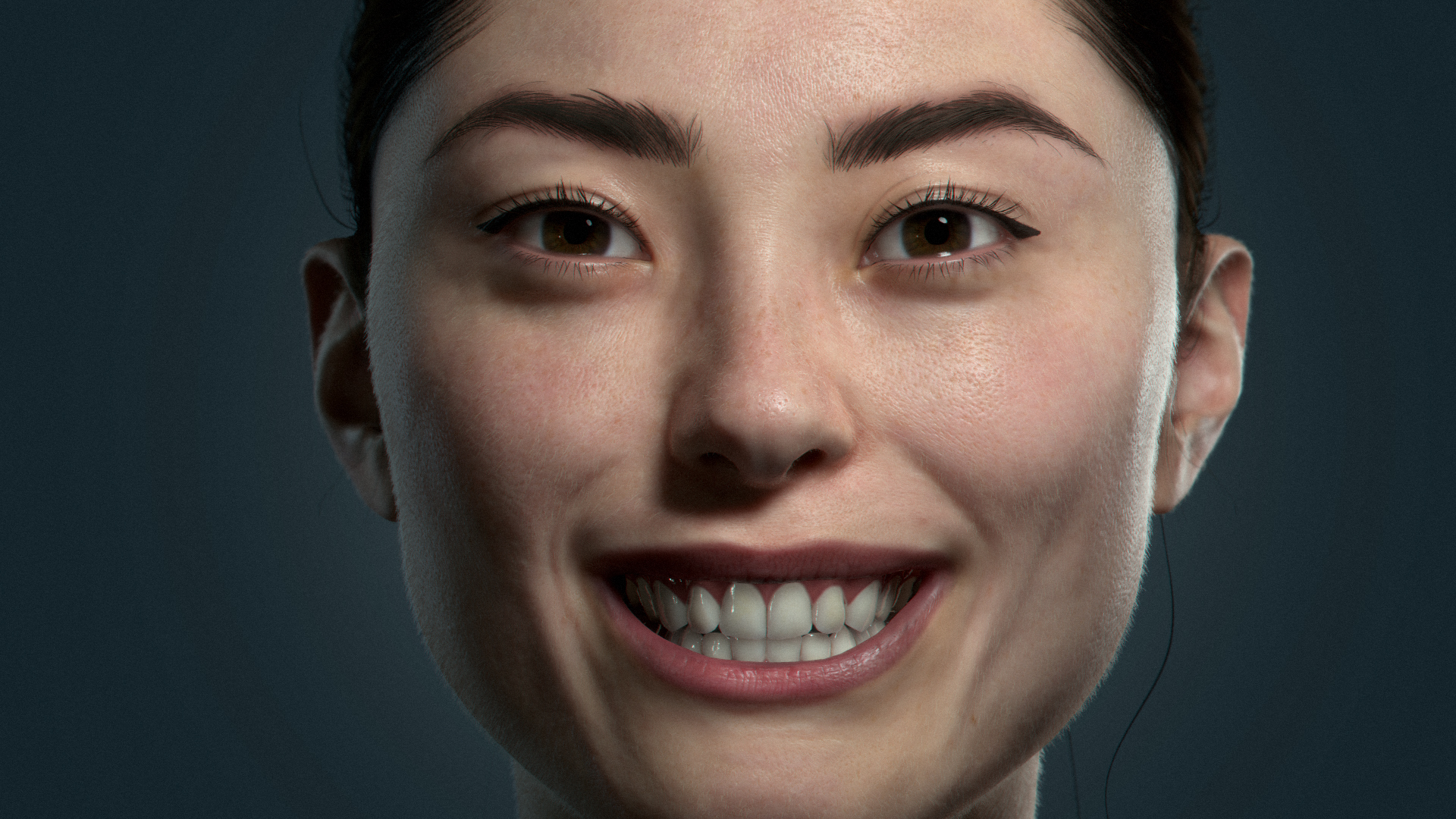
The quality of Toolbag's skin shader has ever amazed me, especially with the variety of results people can produce with information technology. It's simplified, yet provides a lot of control. The first steps I take for creating skin materials are acquiring deportation maps from TexturingXYZ. I project them in Mari and manually sculpt some detail in Zbrush.
Afterward I'm done projecting the maps, I clean up the major pores and wrinkle details on the Diffuse map. Using a combination of Cavity maps from Displacement data and hand sculpted details, my goal is to transfer sculpted data onto the Diffuse and so the details friction match in both the highpoly and Lengthened.
Skin Material
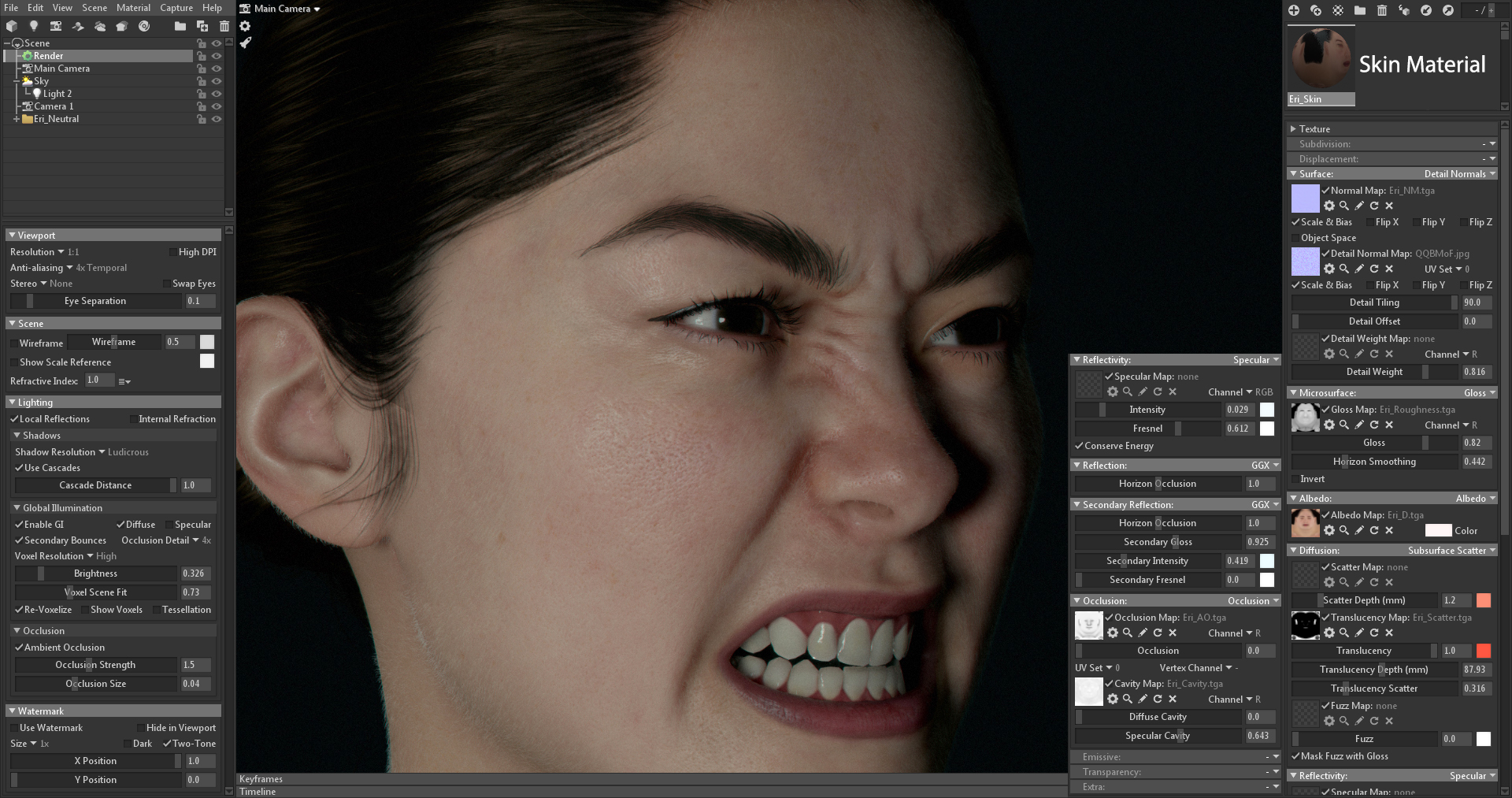
My material setup for Skin is very simple. I use a basic Roughness map with a Cavity map multiplied on top. The Diffusion module is set to Subsurface Scatter and I tint my color to a ruddy tone. I use a Translucency map for the ears and nose by inverting the mesh normals and baking an Ambience Occlusion map. No Fuzz or Specular maps are used since I have actual peach fuzz (more than on this afterward) and use the default physically based Specular value of 0.29. I take Primary and Secondary Specular values; the Primary has a lower Gloss value with a slight blue tint, while the Secondary has a higher Gloss value. The Crenel map volition mask out pores, equally they shouldn't have whatsoever specularity.
Pilus
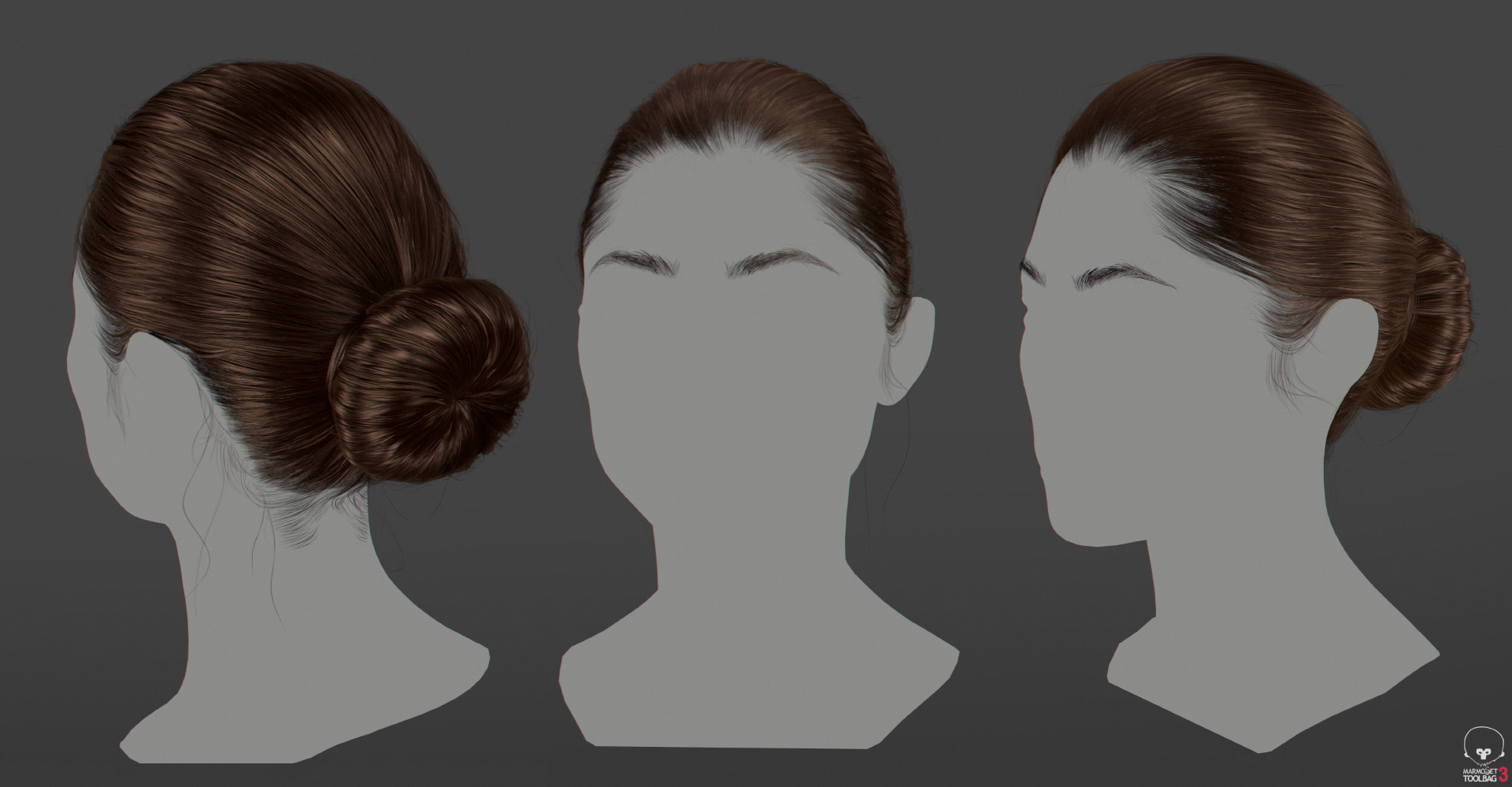
For hair, I use the XGen and Arnold workflow. The hair is created procedurally using XGen descriptions and the textures are baked in Arnold. I'll try to explain the nuts, withal, if y'all're seeking a more indepth tutorial, I highly suggest checking out Adam Skutts pilus tutorial. Keep in mind that information technology doesn't affair if y'all hand paint the hair or employ XGen to generate textures, there are no shortcuts for a practiced result. Building hair relies on manual labour and patience while placing the cards.
Hair Textures
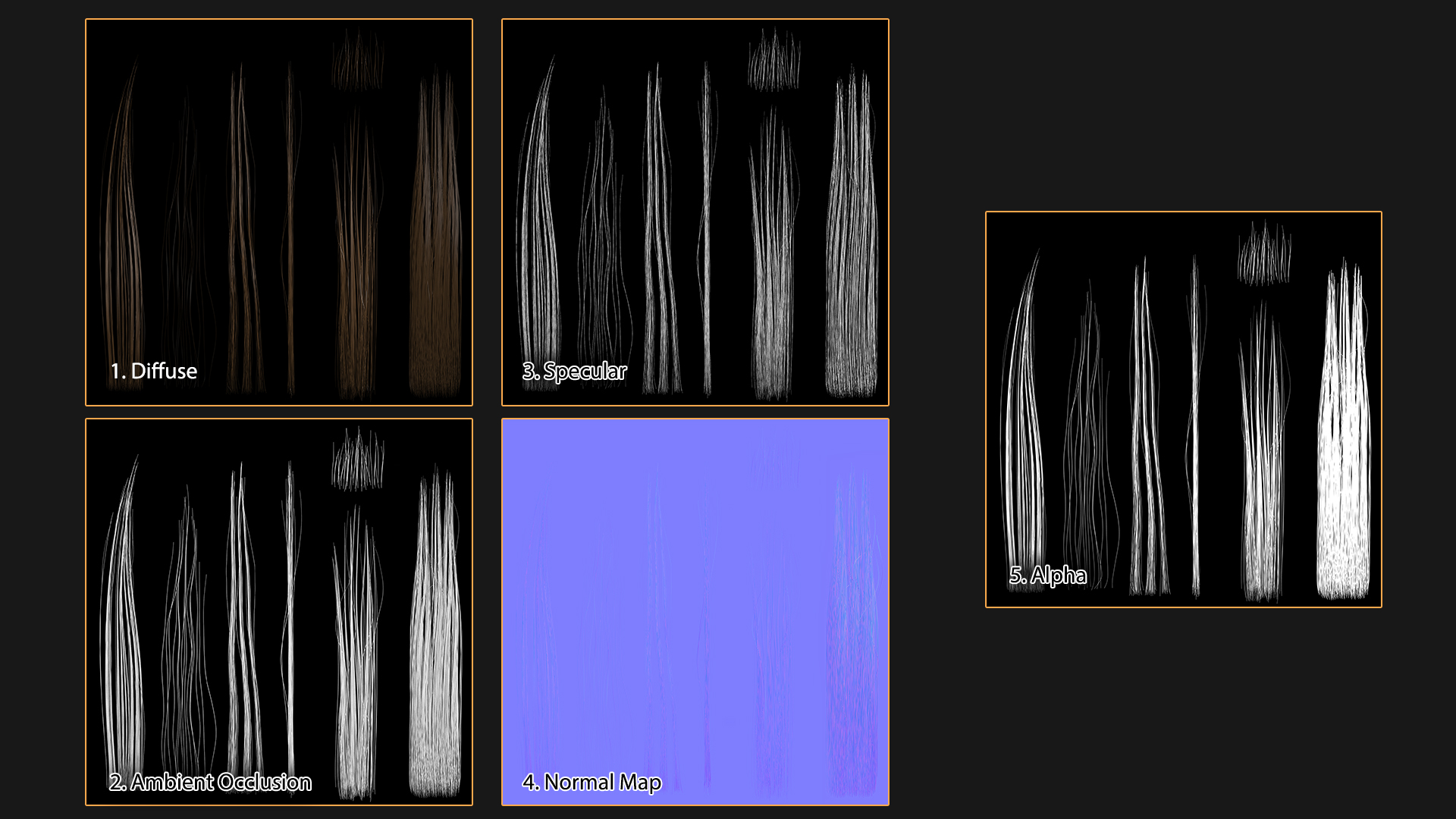
Beneath are the steps I take for creating textures for hair.
- Bake the Lengthened using a standard hair material assigned by XGen. Y'all can choose to experiment with Arnold's hair fabric here. I tend to broil downward hair color and modify it from blonde to black, if needed.
- Convert pilus descriptions to geometry and use aiUtility to bake the AO map. Y'all can have it prepare as a return pass as well.
- The Specular map is but the AO map with a Levels adjustment layer and directional noise multiplied on top.
- The Normal map is broiled with aiUtility. Check out my tutorial on how you can do this.
- The thickness of the tips and roots will touch on the advent of the Alpha map. If it becomes too sparse, the values will decrease from pure white to slightly grey. Depending on the desired consequence, this might exist a result you do or don't want.
XGen Basics
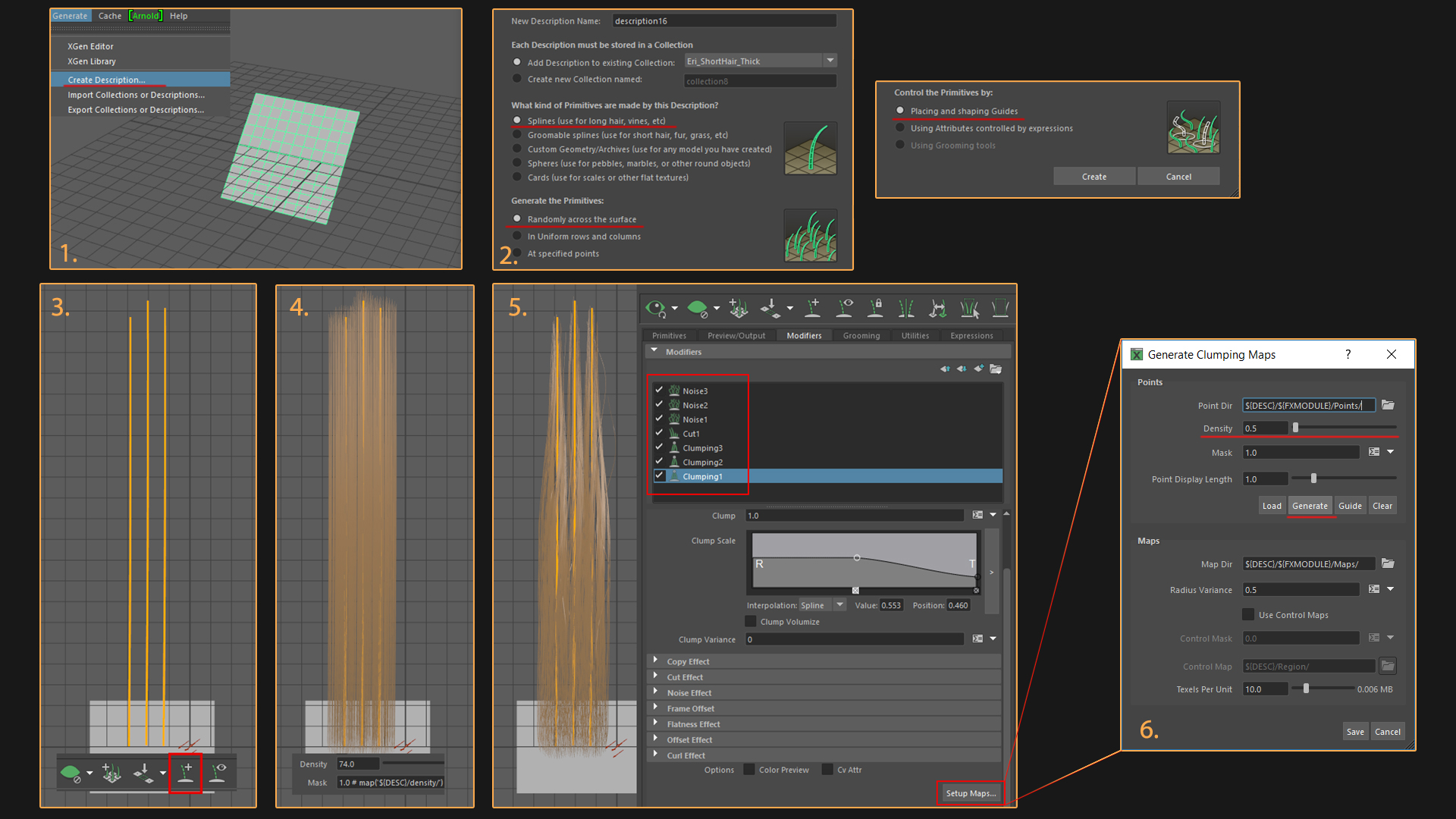
In this department, I'll be giving a quick rundown of XGen and how it can be used to create pilus geometry.
- Create a airplane, select it and pick Generate, then cull Create XGen Clarification.
- Create a Description with these selected parameters.
- Add guides, calibration them to proper length, then sculpt them into desired shape.
- Add Density and paint the Region Mask.
- I use a set up of Modifiers to achieve the expect I'thou going for:
-
- Clump modifier will clump the hair strands.
- Noise modifier adds some noise to the hair. Y'all tin utilise masks here to have racket in specific areas or use the slider to control the noise level across the hair length.
- Cut modifier cuts the hair tips and gets rid of the compatible look.
-
- Each Dodder modifier has a Clumping map. I commonly generate a low density map for the kickoff modifier, a medium density for the second, and high density for the third.
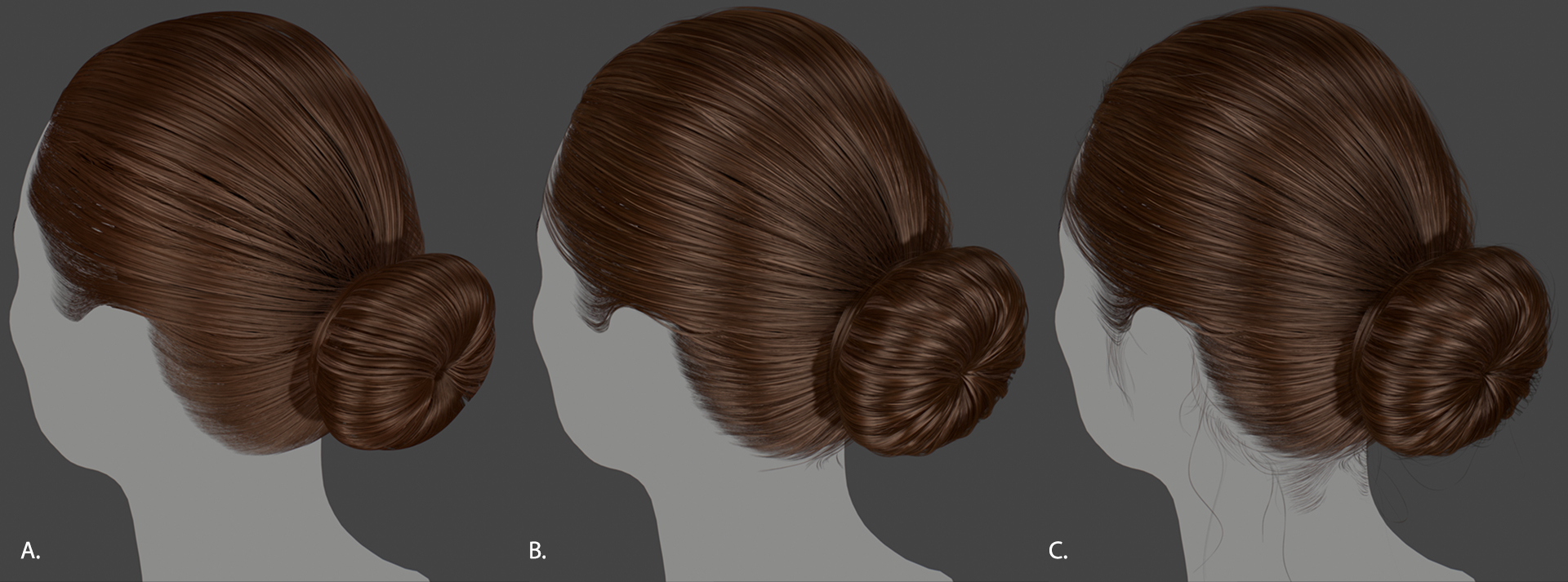
I use a standard hair material that is automatically assigned by XGen and and so bake the Diffuse, AO, Alpha, and Normal maps. Once your textures are baked or painted, yous should showtime placing the hairs and work in layers. I would recommend sculpting the haircut in ZBrush start to establish hairline, book, period, and proportions. The sculpt besides helps you build the showtime layer for your hair. You tin approach hair placement as if it's retopology – simply placing hair cards on peak of the sculpt.
-
-
- The starting time layer is just a bunch of hair cards that establish the hairline, mass, and direction. This layer should be thick so that information technology covers the scalp completely, with no visible gaps.
- The second layer has thinner pilus strands that add volume, intricacy, and breakup the monotony of the hair.
- The third layer is equanimous of transitional and flyaway hairs. Transitional hairs are used to create ameliorate transition between the scalp and hair. Flyaways are wilder hairs that break upwardly the silhouette and can take hold of the light to create a fuzzier await.
-
Hair Material
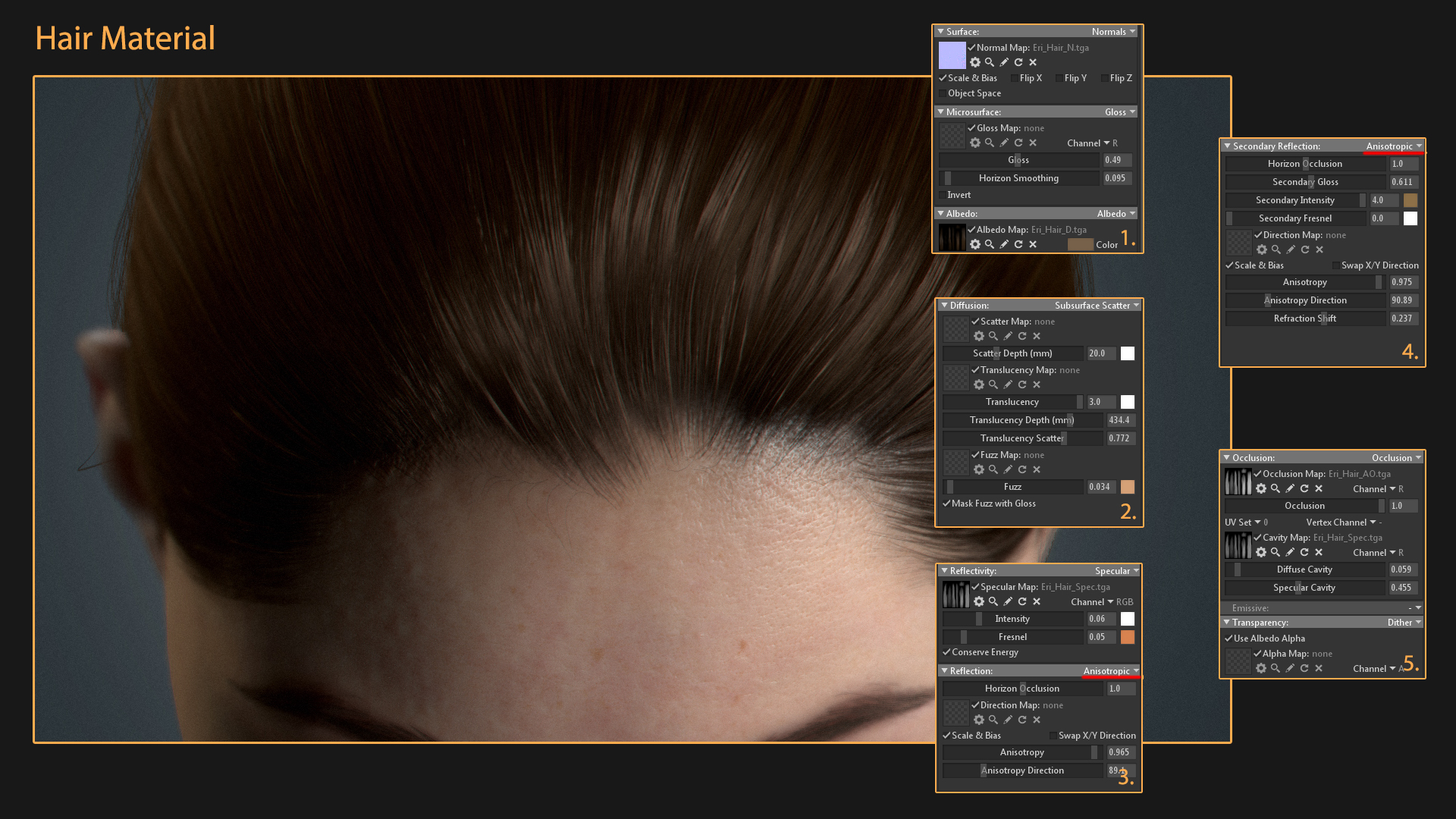
Your pilus material settings volition vary depending on your lighting setup, too as the Lengthened and Specular maps. However, there are a few primal things to remember when building the cloth. Pilus will take Master and Secondary Specular highlights; Main is shifted towards the pilus tip, and Secondary towards the hair root. Both of these will have different colors applied.
- Diffuse map with additional color.
- Lengthened module prepare to Subsurface Besprinkle. Handful and Translucency values are set very high to simulate calorie-free passing through the hair and give information technology a softer look. A slight amount of Fuzz can fake rim light, however I'd avoid using information technology for the virtually function.
- The Primary and Secondary Reflection types should be prepare to Anisotropic.
-
- Principal Reflection is shifted towards the hair tip. It should have a tight highlight and the color should not be tinted, if information technology is, it should exist subtle. Anisotropy Direction usually looks practiced around the 70-90 value range, but this will depend on the hair cut.
- Secondary Reflection has a slightly broader, tinted highlight. Fresnel can be turned off since you won't need two of them. Secondary Reflection is shifted towards the hair root (in that location'due south a Refraction Shift slider for this).
-
- I plug the Specular map under Cavity. The Specular Cavity slider is used for masking out specularity and can exist useful for depth and hair separation.
Peach Fuzz
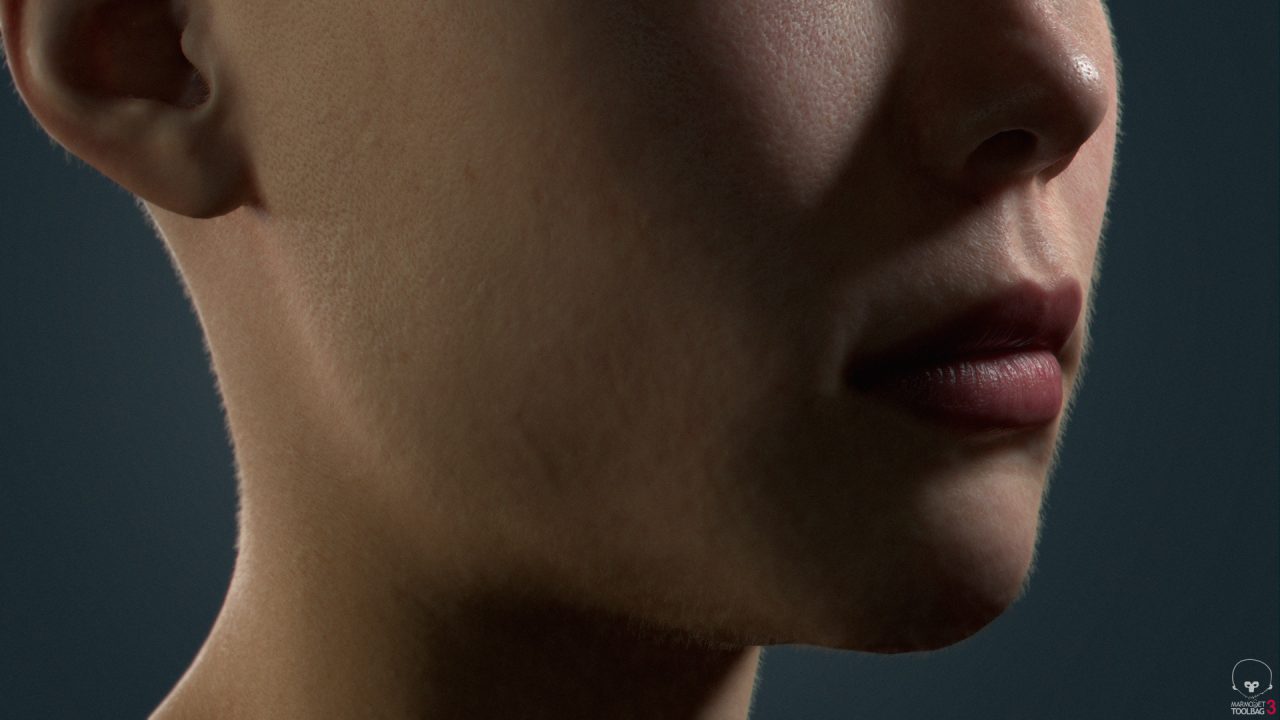
Peach fuzz is known equally Vellus hair, which are curt, thin, translucent hairs that cover a person'southward torso. They're very subtle, even so they can exist prominent on some faces. I used Zbrush's FiberMesh to create my peach fuzz. In that location'southward no secret technique to simulated information technology, it'southward just a lot of geometry. The key is to nail the density and length. You lot can download my Fibermesh preset and pare cloth here. The Fibermesh preset should piece of work right out of the box, with possible adjustments to length co-ordinate to your needs. I've discovered that tubes work better than planes. Although, I programme to run more tests using planes to make them look just every bit good due to the loftier poly count of tubes.
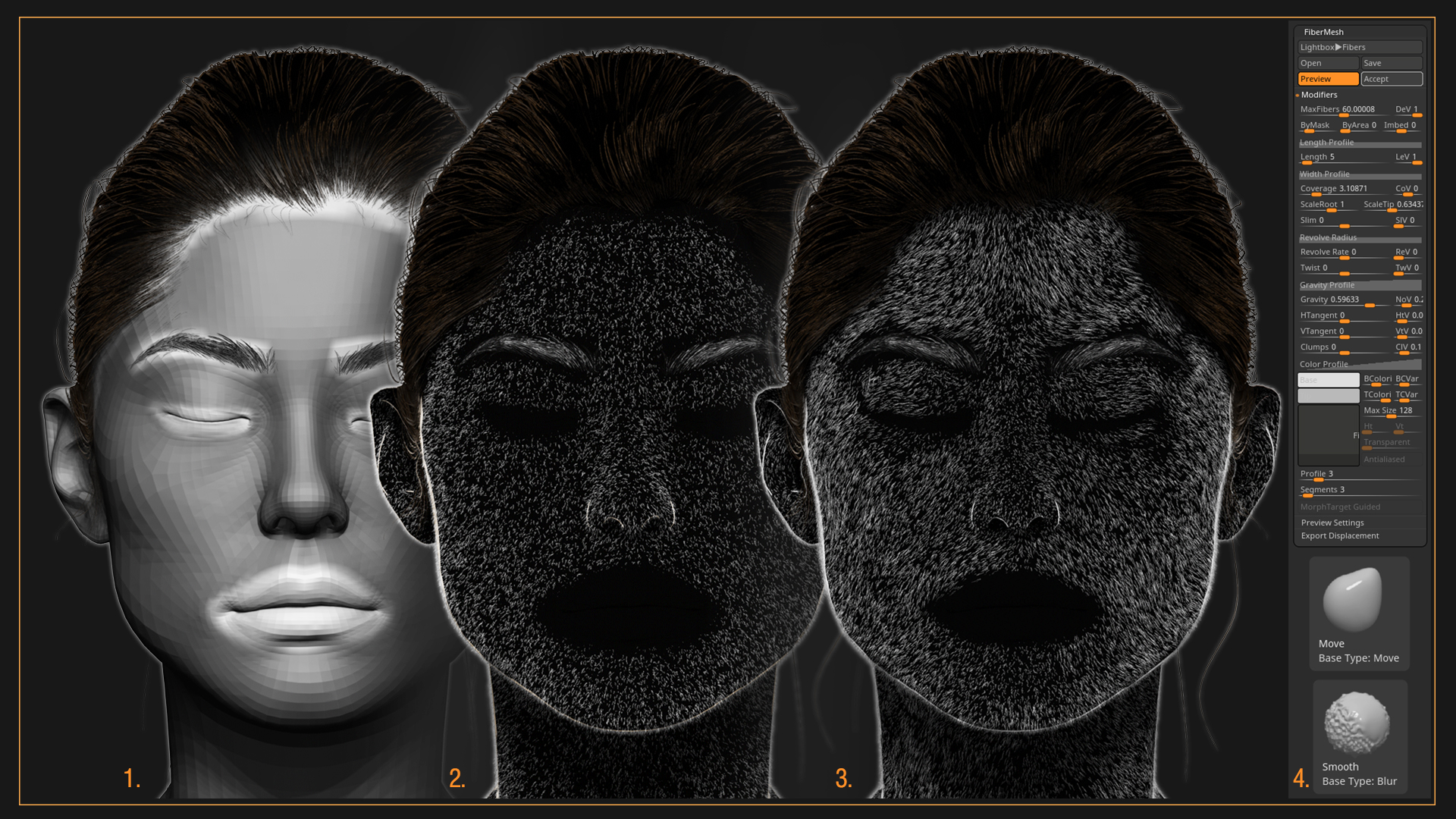
In steps ane and 2, I mask out areas in Zbrush where I don't want peach fuzz, then use the FiberMesh preset. Once y'all're happy with the preview, click Accept to commit the changes. Steps 3 and 4 display the management command of the peach fuzz. Yous should constantly check the silhouette to make certain the length remains uniform. Use the Smoothen castor hither to cutting length. Once you're happy with the result, export the mesh.
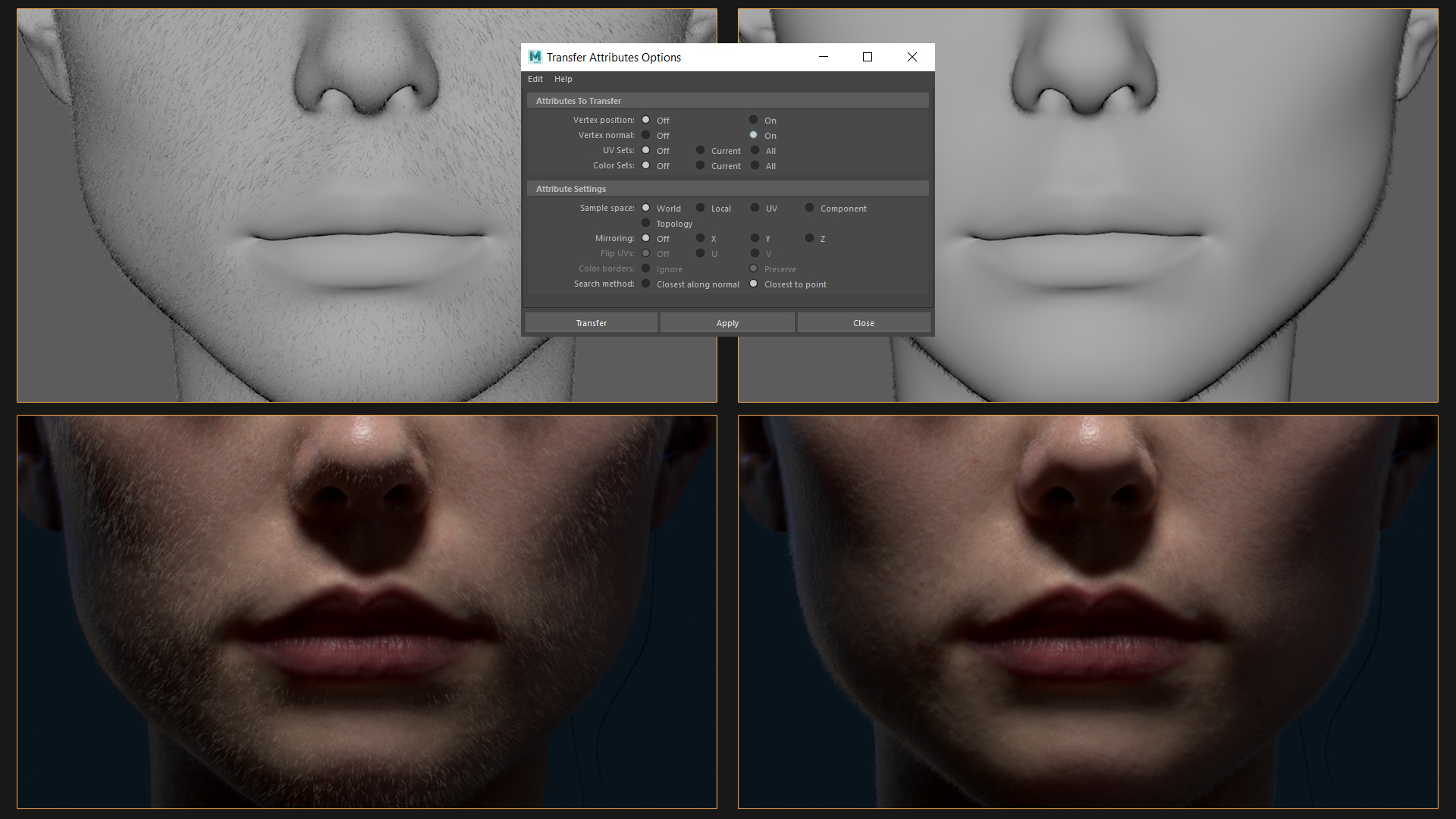
The of import trick hither is to transfer the normals of the face mesh to the peach fuzz. This will smooth out and basis the fuzz. In Maya, select the confront geometry, select the peach fuzz, and so click Mesh -> Transfer Attributes.
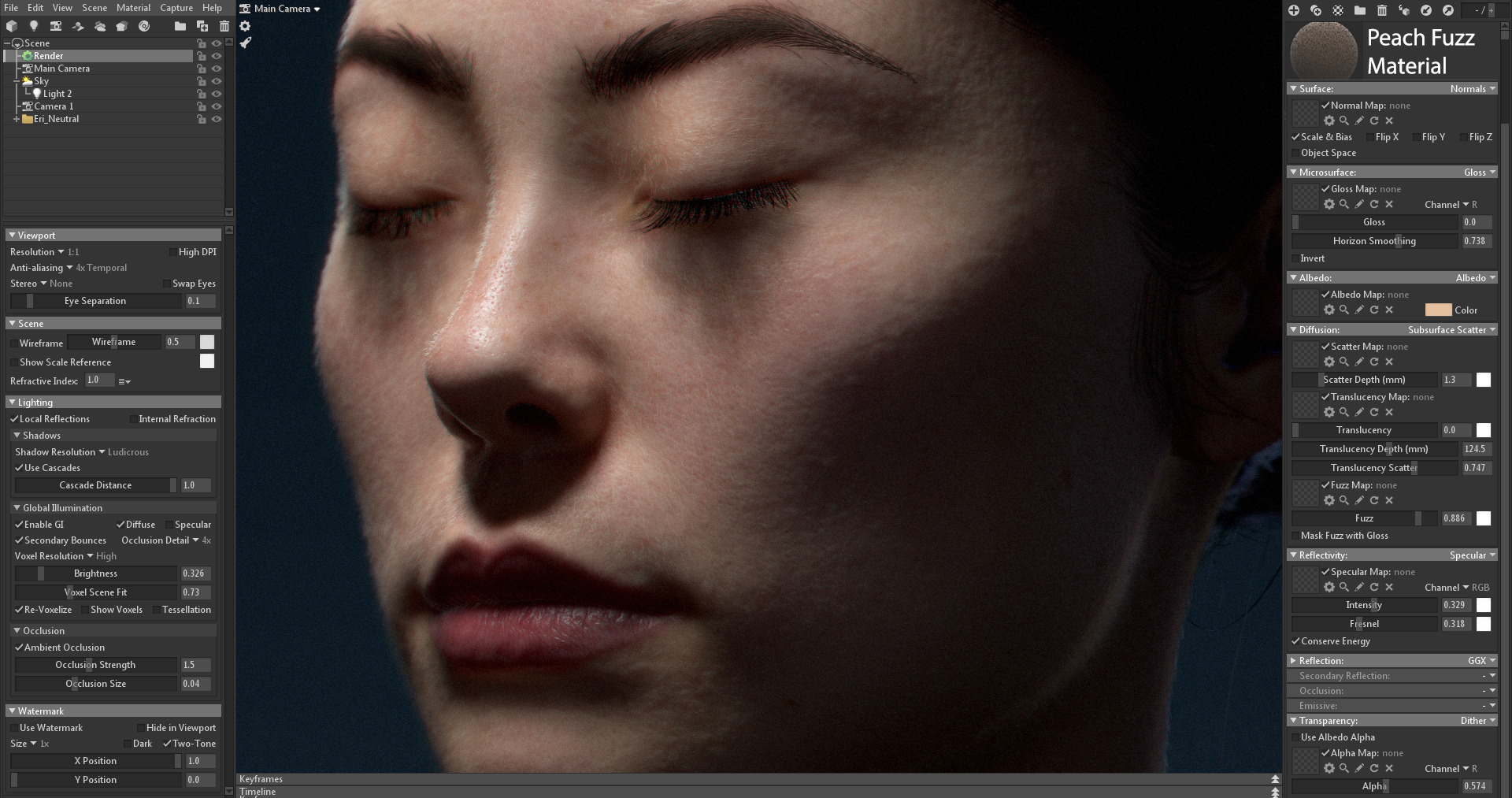
The fabric setup in Toolbag is very basic. Simply tint the Albedo color to a light yellow and set the Transparency slider to a halfway betoken.
Notation: Peach fuzz is a lot of geometry, so await some drops in performance. The Speedy Viewport option really helps in this instance.
Eyes
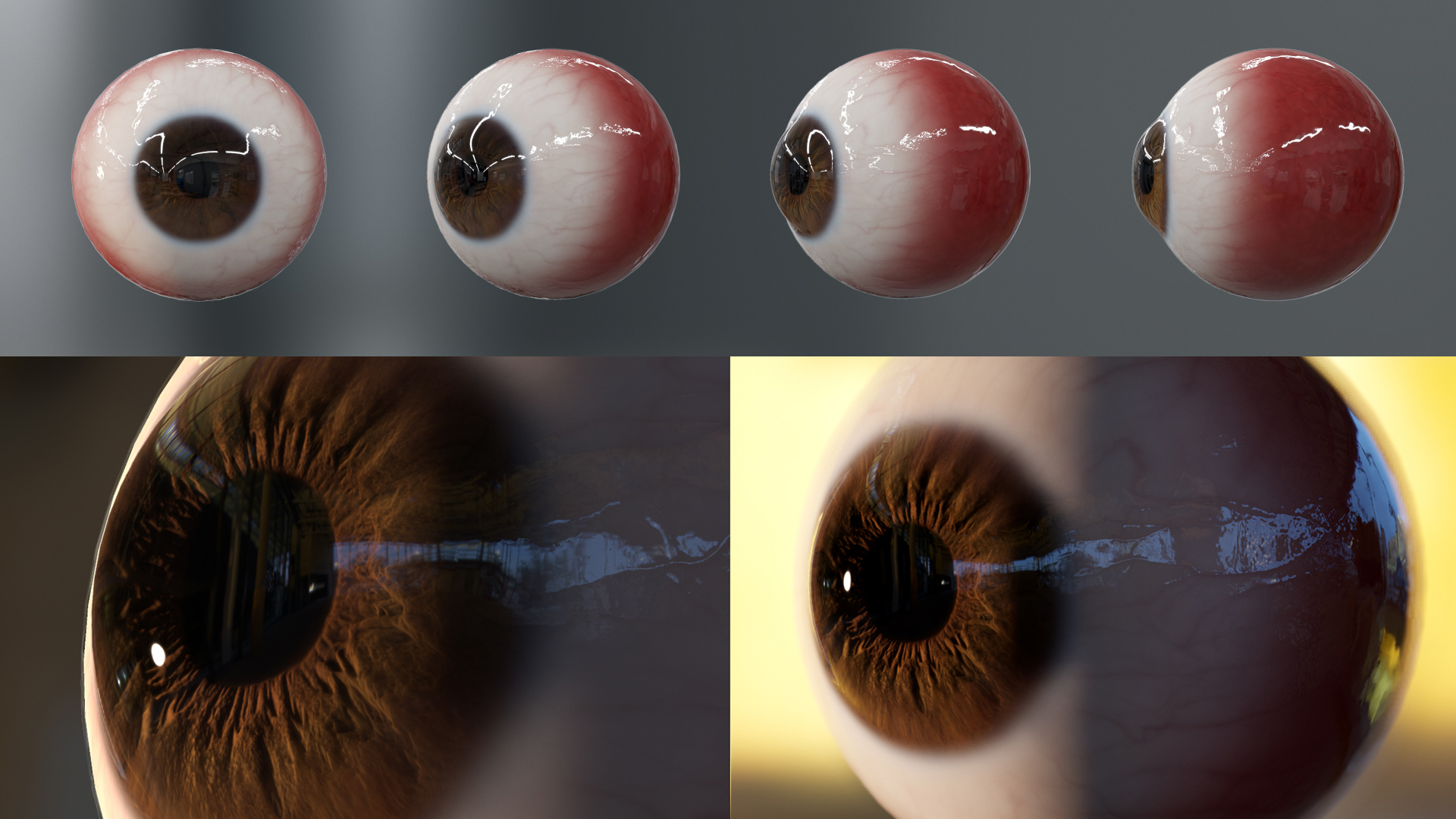
The way I create eyes is a slightly improved version of Peter Zoppi's method. You tin too get familiar with the method by reading Saurabh Jethani'due south tutorial. If you think Peter Zoppi'south method is difficult – don't worry! I've provided a template that you tin utilise freely, improve upon, and experiment with!
Zoppi'southward method is the best approach to faking refraction. In Zoppi's method y'all utilize photos and convert them to Normal Map. My method allows y'all to sculpt your own iris and have greater control over the transition between the cornea and iris. This creates a softer and more natural look. The tradeoff is that it requires an extra step.
Centre Geometry
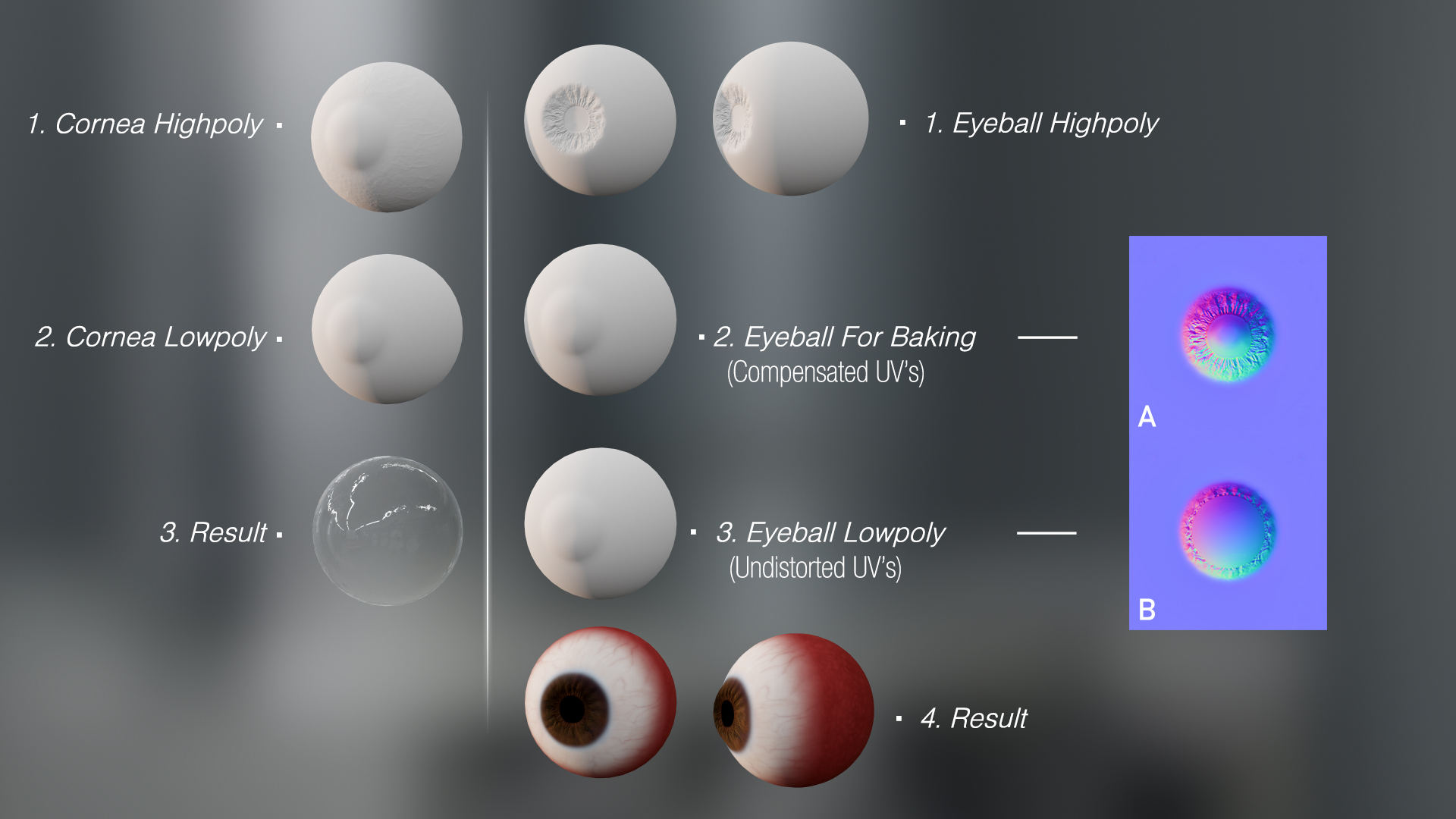
Let's take a wait the meshes that brand up the eye.
Left:
- Cornea Highpoly: includes veins and surface breakup for baking.
- Cornea Lowpoly: for terminal use in-engine.
- Consequence.
Right:
- Eyeball highpoly: this is a concave mesh that will be baked down on the convex eyeball lowpoly with compensated UVs (Eyeball for baking).
- Eyeball for baking: this mesh will be used only for blistering.
- Eyeball Lowpoly: this mesh is for your terminal in-engine character.
- Consequence in one case textures are applied.
-
-
- This is the Normal Map result when baking with the "Eyeball For Blistering" mesh.
- This is the Normal Map result when baking the "Eyeball Lowpoly".
-
The eye workflow requires baking concave geometry (Eyeball Highpoly) onto convex geometry (Eyeball Lowpoly). As a event, you'll go a distorted Normal map (B). Bounty is needed for this baloney, so you'll need to utilise the Eyeball for Baking mesh to distort the UVs in the opposite direction and get the required outcome (A). The Eyeball For Blistering mesh is used but for blistering to generate a non-deformed normal map (A) that later will be practical to the undistorted Eyeball Lowpoly in-engine.
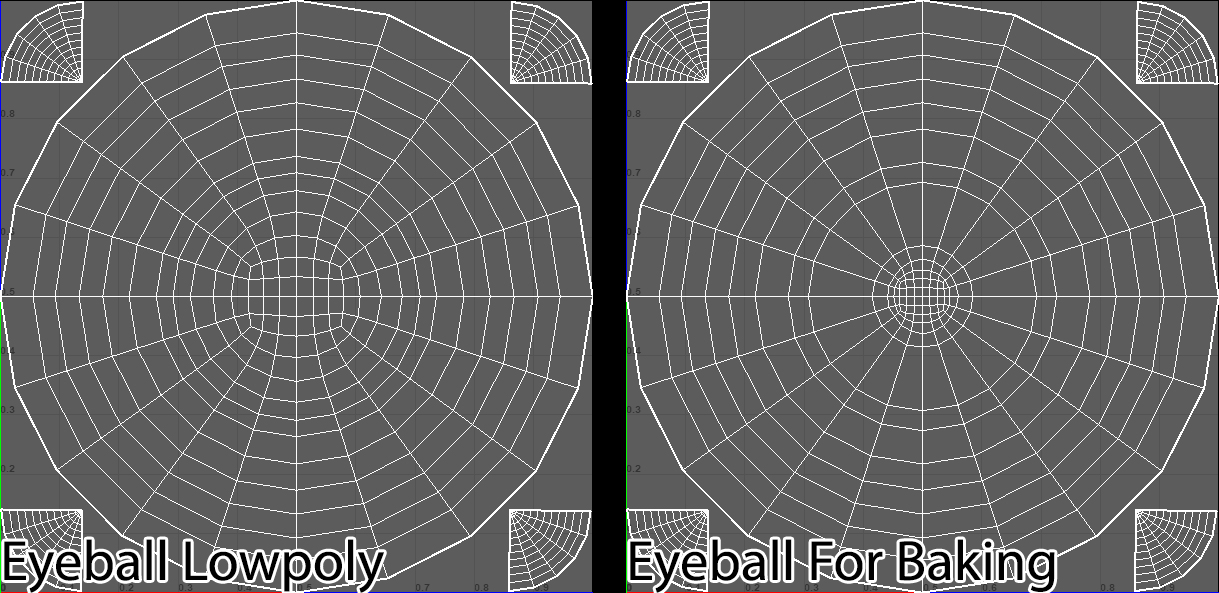
An illustration would be to imagine an paradigm taken with a fisheye lens. Your goal is to remove the baloney generated by fisheye lens. If you use the proper, undistorted UVs for baking (Eyeball Lowpoly), the normal map, or any map baked volition have a fisheye baloney. This is because you're baking concave iris geometry onto a convex surface. To ready this – nosotros need a mesh that has compensated UVs (Eyeball For Baking), significant that the UV's are distorted to compensate for the fisheye distortion.
Iris/Heart Textures
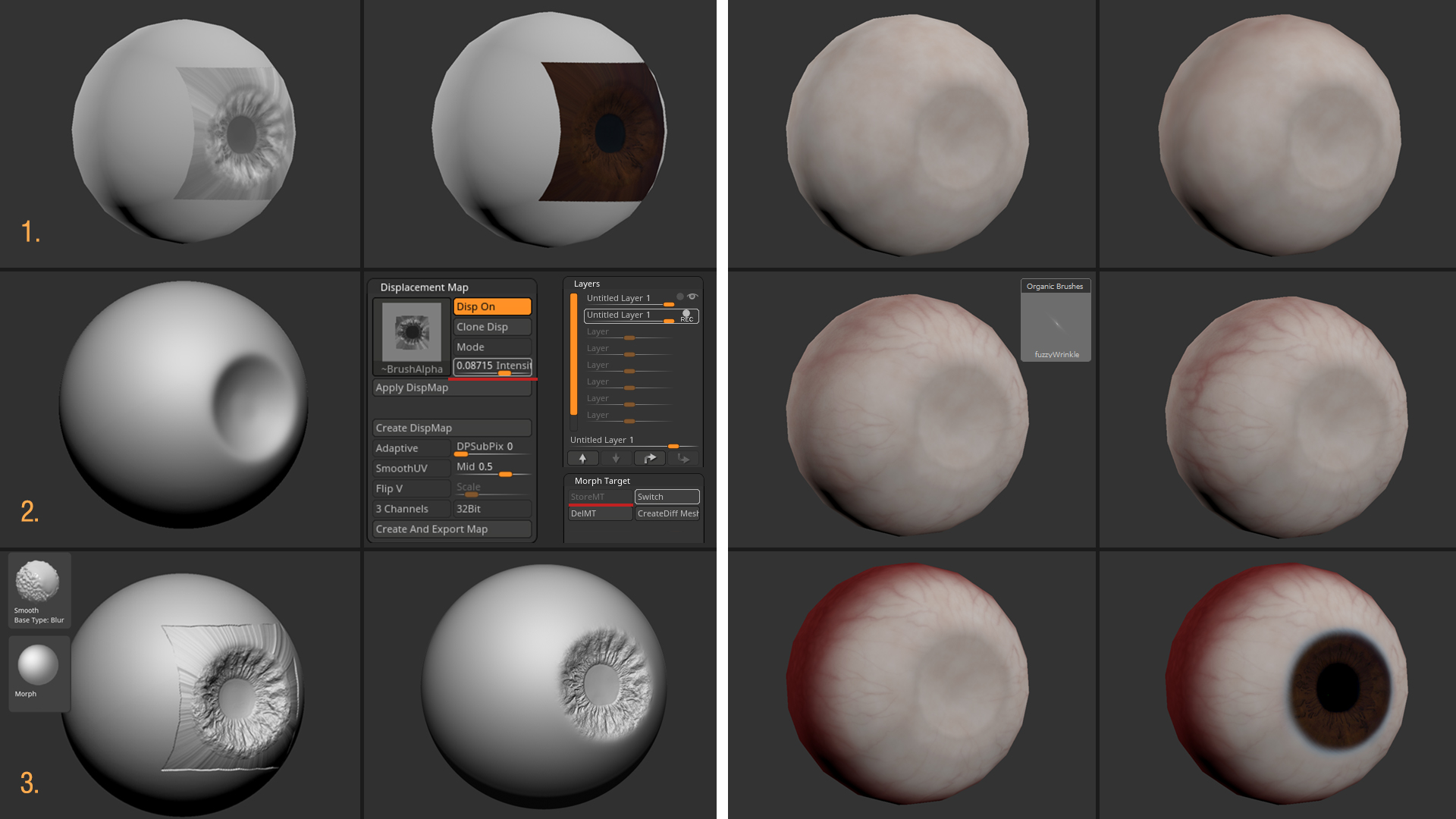
- I start by using using iris scans from TexturingXYZ. The benefits of using TexturingXYZ is that the displacement data matches the diffuse data. I then project the textures in Mari on the highpoly eyeball.
- Once I create my maps, I export them. I tweak the Deportation Intensity in Zbrush and click Utilise once I'm happy.
- At this point, the transitions must be smoothed out. I piece of work in layers and use morph targets to do so.
The cornea is painted in Mari using a mix of procedurals and handpainting. I use the "fuzzyWrinkle" brush to paint the veins, which can be establish under the Organic Brushes tab. I normally do a combination of vein layers with unlike opacity and blur levels. For the Cornea highpoly, I merely employ some dissonance brushes and import a hand painted vein mask to inflate detail. This way, the veins in the Diffuse will match the veins in the Normal Map.
The iris is added at the finish. I of the things I like to do is to add a subtle blueish tint on the outer edge of the iris. It's not important, only it's an observation I've made when looking at close-upwards images of irises.
It's of import to note that if y'all were to desaturate the pare and cornea textures, the value of the cornea should not be lighter than the skin. Otherwise, the eyes will glow and appear too white.
Eye Material
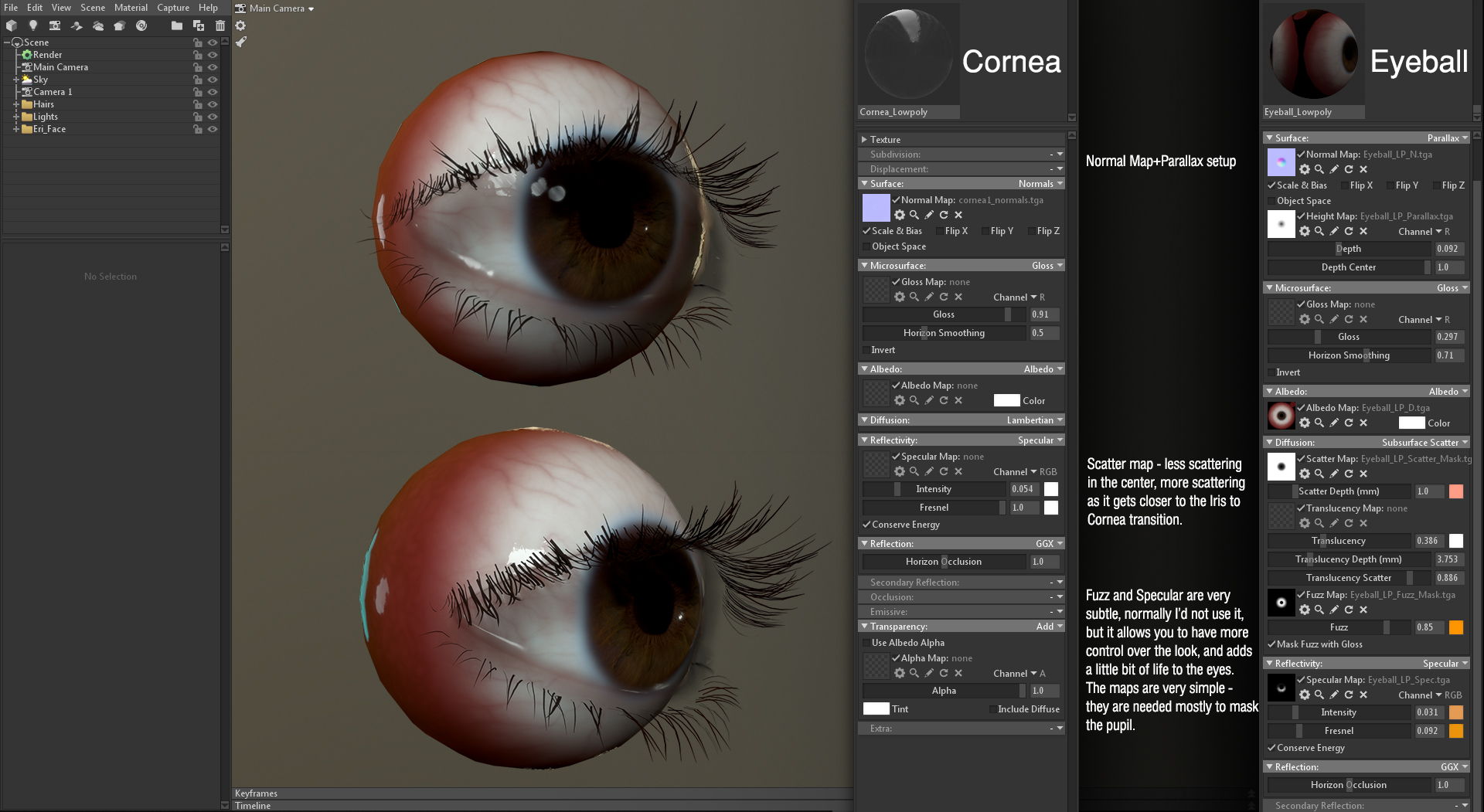
The setup for the eye textile is straightforward. You'll need nicely painted textures, a Normal map, and a parallax setup that works well. Anything extra is personal preference.
Transitional Meshes
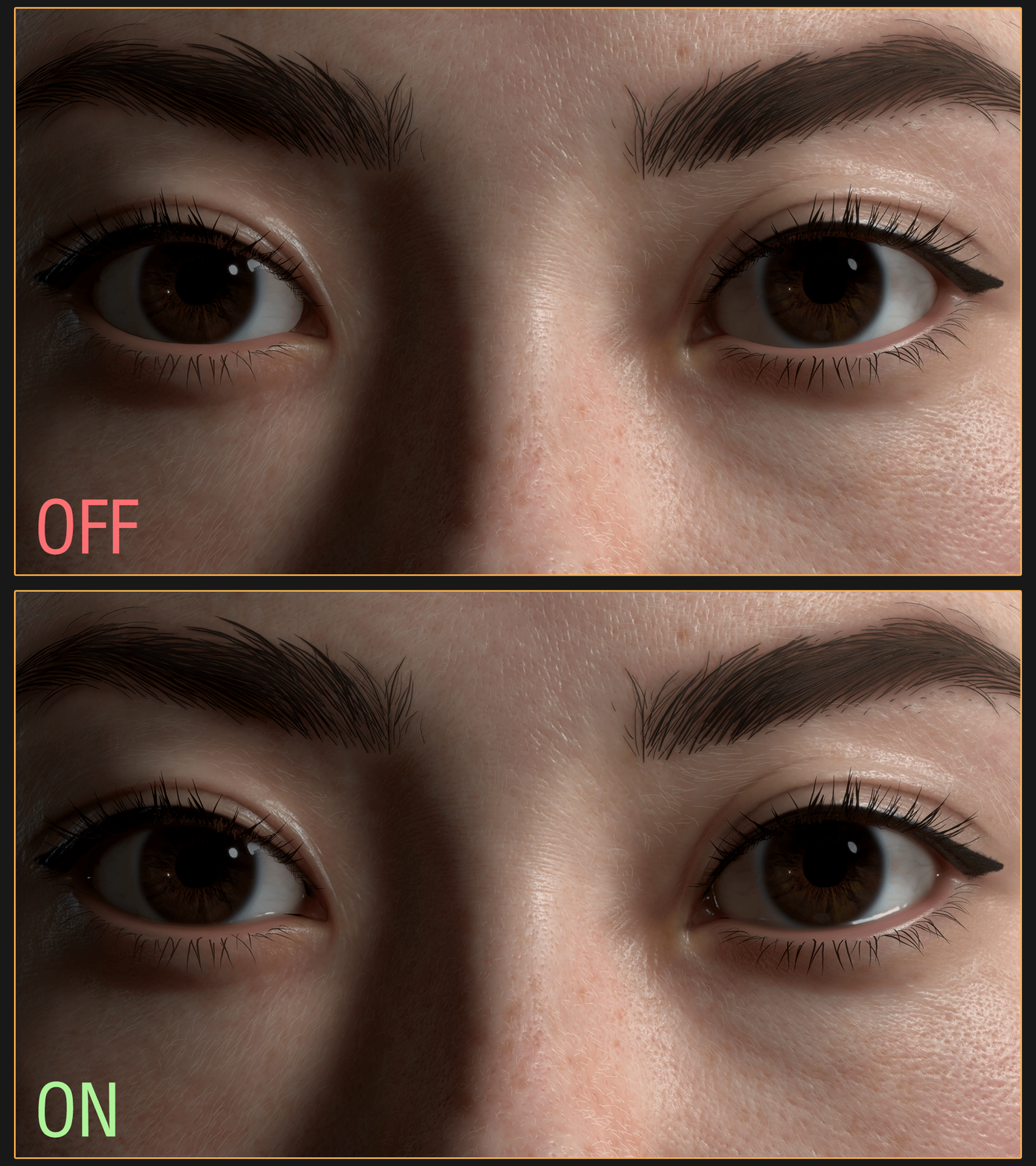
Transitional meshes are meshes that blend two separate objects. For case, eyeballs to lids, and teeth to gums. I've made a tutorial about transitional meshes where I outline two methods. For this article, I'll outline the best and easiest method. The most recent version of Toolbag supports Dithering with Refraction. This can be plant in Refraction under the Transparency module. The transitional mesh will blur anything backside it and a slight blur is what we need.
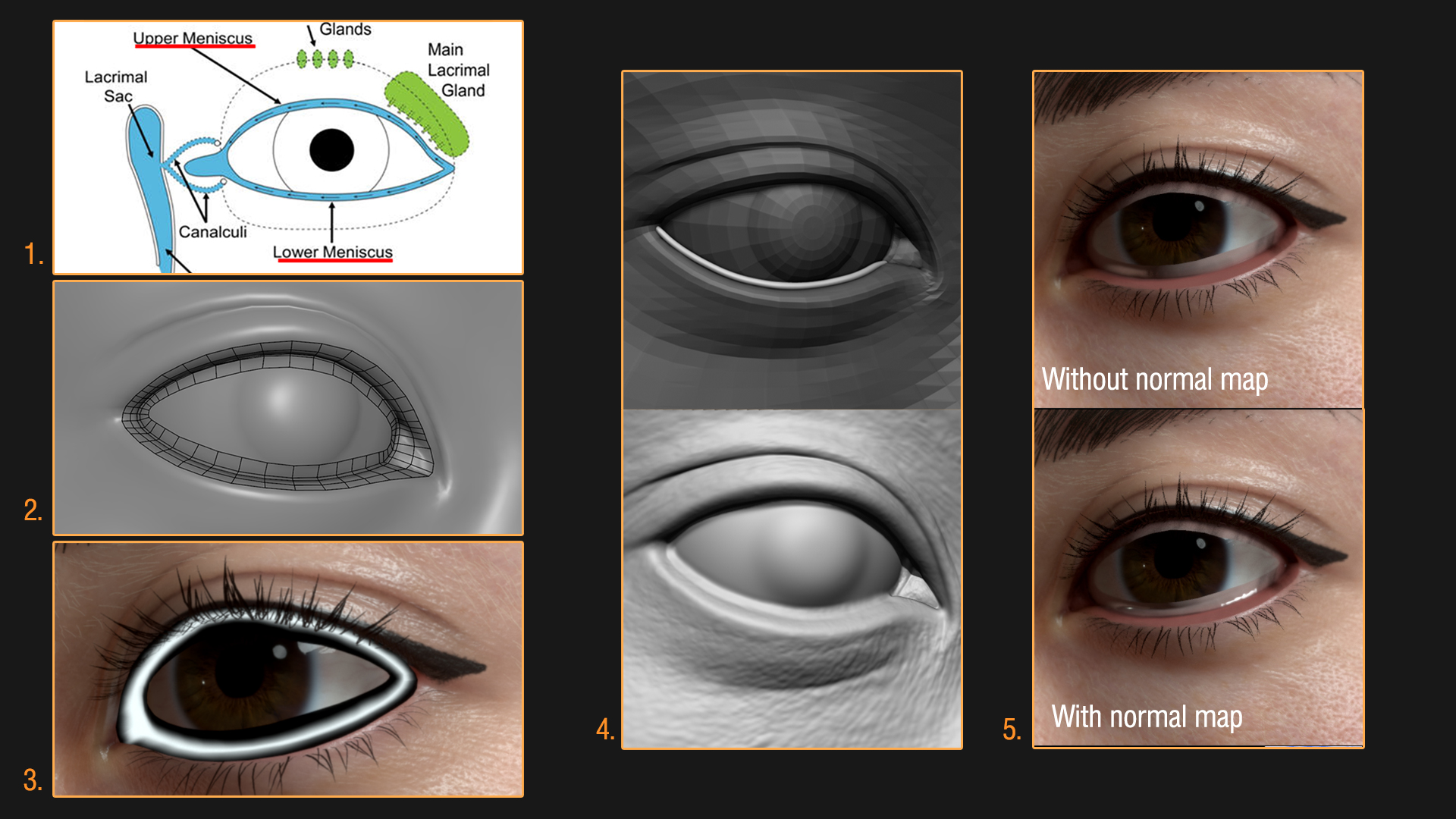
- Bated from the blur and apoplexy betwixt the optics and eyelids, in that location'due south a thin strip of tear fluid chosen the upper and lower tear menisci. These fluids create subtle highlights that assist sell the realism of the eyes.
- I create a transitional mesh between the eye and eyelids in Maya. Make sure the mesh is just floating in between the optics and eyelids with no overlapping.
- This is my opacity map which I painted in Substance Painter. You don't want your transitional mesh to have any visible sharp edges, and then mask this out.
- I create a highpoly mesh that simulates the tear fluid. You can insert a tube shape and it should exist good plenty. In my case, I like to combine all the geometry and dynamesh information technology in Zbrush. The fundamental here is to bake a convex surface on a concave transitional mesh to emulate the highlight that appears on the tear fluid.
- Once the Normal map is baked, we can see the desired highlight.
Transitional Material
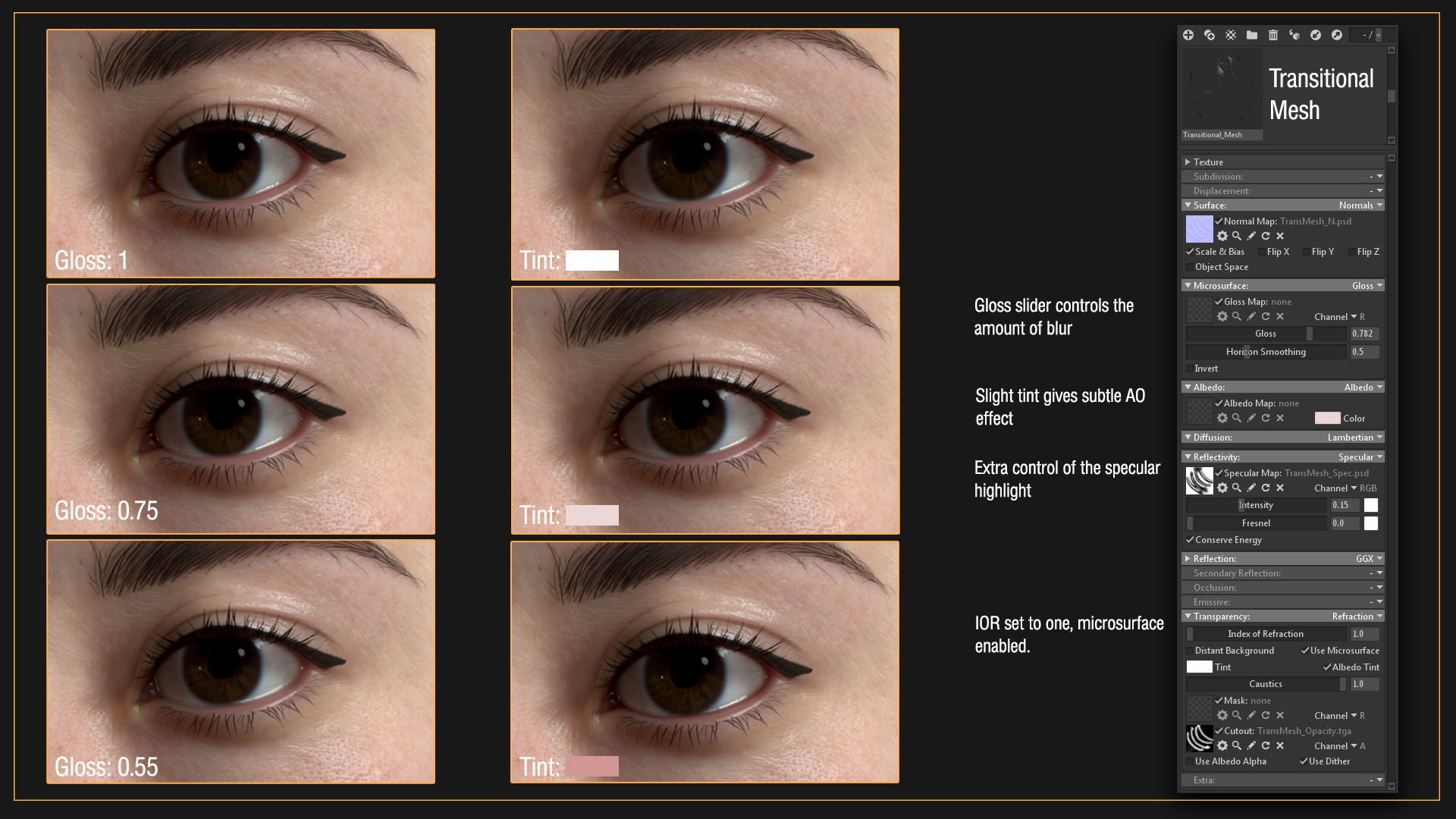
For the textile setup, you'll need a Normal map for the tear fluid highlight and an Opacity mask. Refraction Blur is responsible for all the magic. Plug your Opacity mask underCutout and cheque Use Dither. You'll now see that anything placed backside the transitional mesh is blurred. The Gloss slider volition control the corporeality of blurriness.
Presentation
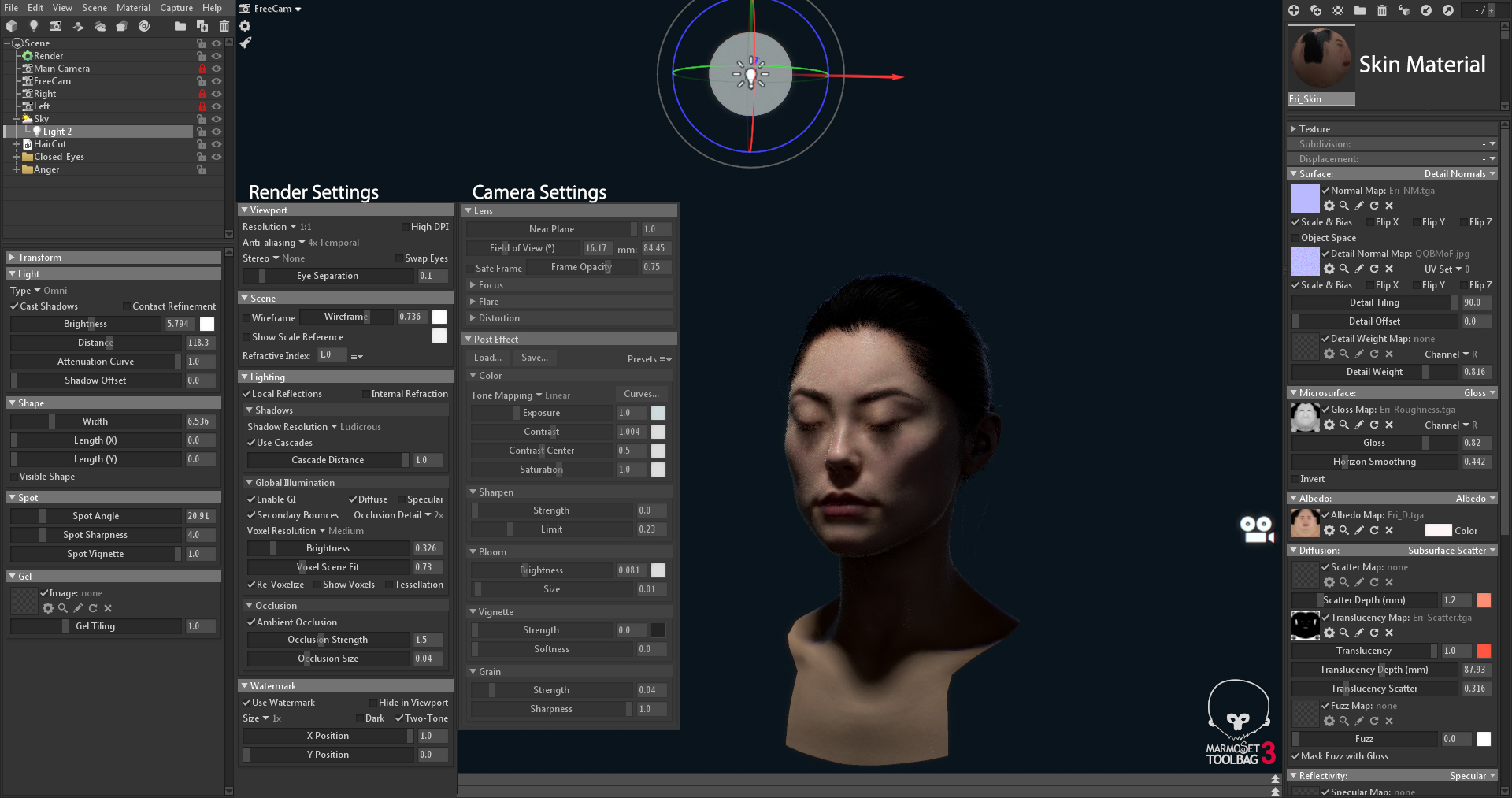
My lighting setup consists of an Omni lite placed above and a Sky Light. I tried out a few unlike lighting setups, just ultimately decided to use the simpler one for the presentation. Information technology demonstrates that Toolbag tin can produce good results using one calorie-free with almost no tweaking to its default settings.
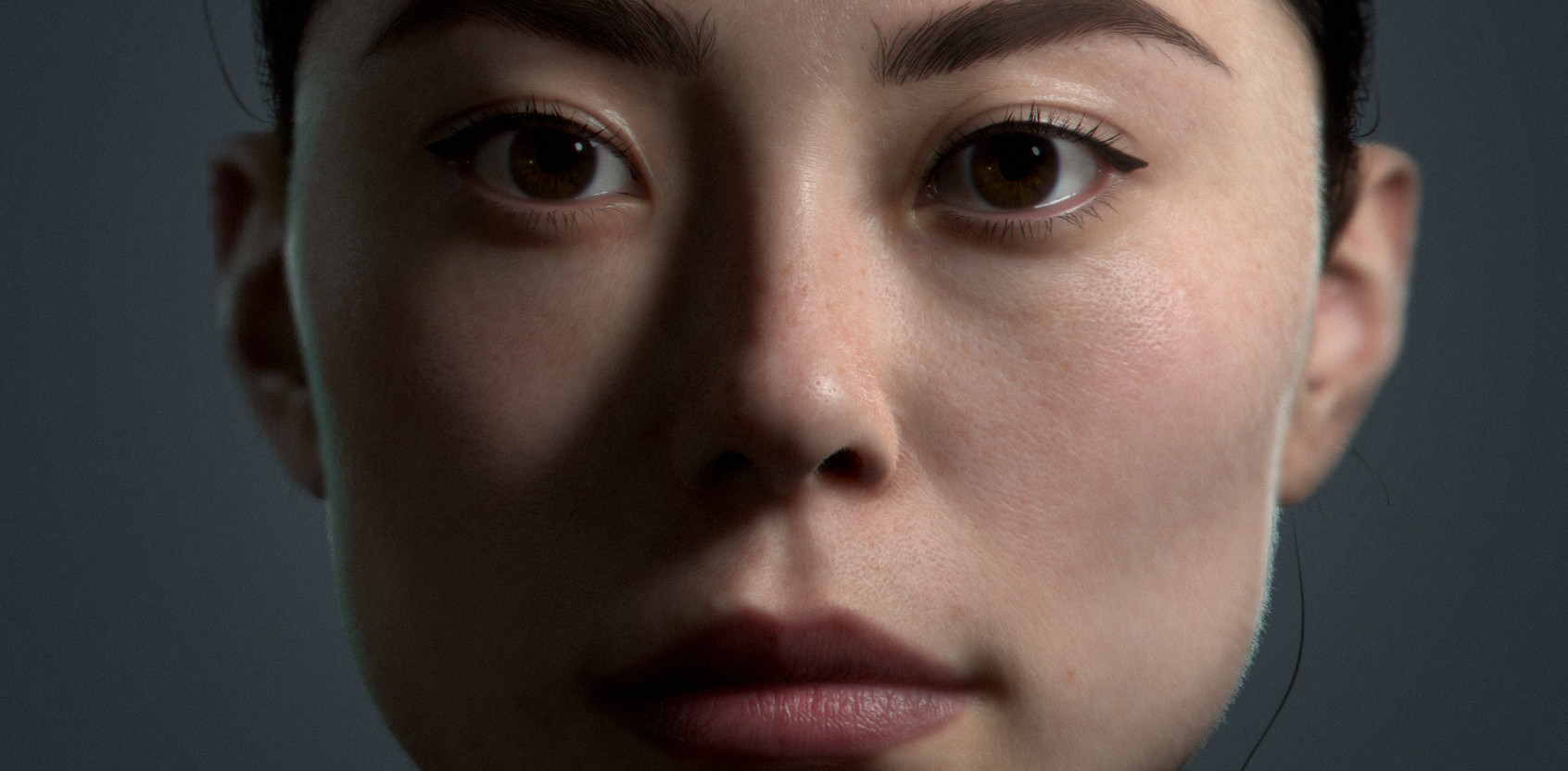
Thank you for reading, I hope it was helpful! A special thanks to the Marmoset team for helping me write and edit this breakdown article.
We would similar to thank Vadim Sorici for writing this breakdown. Y'all tin can discover more of Vadim'southward work on Artstation. Find out how Toolbag can bring your grapheme art presentation to the next level with the 30-day free trial, and visit our Tutorials section for more breakdowns.
Source: https://marmoset.co/posts/how-to-create-realistic-hair-peach-fuzz-and-eyes/
0 Response to "how to draw same size hair cards 3d"
Post a Comment